

ISO 14001 – The New Revision Is Ahead of Us
ISO 14001 – The new revision is ahead of us!
ISO 14001 is under revision: key developments you should know
With environmental risks and climate pressures increasing globally, more and more organisations face the need to proactively advance their environmental protection practices. ISO 14001, as one of the most significant standards for environmental management systems, is undergoing its first substantial revision since the 2015 edition.
The forthcoming version ISO 14001:2026 aims to respond better to contemporary environmental and business challenges, with a particular focus on climate change, the life cycle based approach and closer integration with business strategies. The reasons for the revision and the most important expected changes are set out below.
Why is ISO 14001 being revised?
The current version of ISO 14001 was adopted in 2015 and is currently in the final phase of revision (FDIS – Final Draft International Standard). Like all ISO standards, this one is reviewed periodically, usually every five years, in order to ensure its alignment with new legal obligations, market expectations and global trends.
In addition, the revision aims to achieve better alignment with the other ISO management system standards. The new edition, ISO 14001:2026, will officially replace the version ISO 14001:2015, significantly emphasising the role of organisations in addressing climate change and wider environmental issues.
Key developments in ISO 14001:2026
1. Alignment with the harmonised structure (HS)
The standard is being adapted to the new harmonised structure, which replaces the previous high level structure. The changes mainly concern terminology and the arrangement of the content.
2. Extended terms and definitions
Clause 3 is supplemented with new terms and definitions, taken from the harmonised structure, for the purpose of clearer and more unified application.
3. Context of the organisation and climate aspects
In Clause 4, the content of ISO 14001:2015/Amd 1:2024 has been integrated and extended, with particular emphasis on climate change. In addition, other relevant environmental topics are covered, such as greenhouse gas emissions and the protection of biodiversity, with more detailed guidance and explanations.
4. Interested parties and transparency
The information that organisations should share with interested parties is clearly defined, particularly regarding sustainability and product characteristics within the supply chain.
5. Extended life cycle approach
Life cycle consideration, which already exists in the standard, gains greater significance and should be integrated more deeply when defining and applying the environmental management system.
6. Structural alignments and management of change
The titles and content of individual clauses have been further aligned, particularly Clause 6 (risks and opportunities) and Clause 10 (improvement). Another development is the introduction of Clause 6.3, which relates to the systematic management of change.
7. Improved clarity of wording
Certain wordings have been made more precise in order to facilitate understanding and simpler application of the requirements in practice.
What comes next for organisations?
The publication of ISO 14001:2026 is expected at the beginning of 2026. Following its official issue, organisations will have a three-year transition period to align with the new requirements. During that period, certificates issued according to ISO 14001:2015 will remain valid.
The transition to the new version may be carried out within a regular surveillance or recertification audit. It is recommended that the responsible persons familiarise themselves with the final text of the standard in good time and begin planning the necessary changes, so that the transition to ISO 14001:2026 is efficient and without interruption.
For more information contact us at: office@t-cert.mk, by phone on +389 2 3221 603 or write to us using the contact form.
Keep Reading
Related Articles
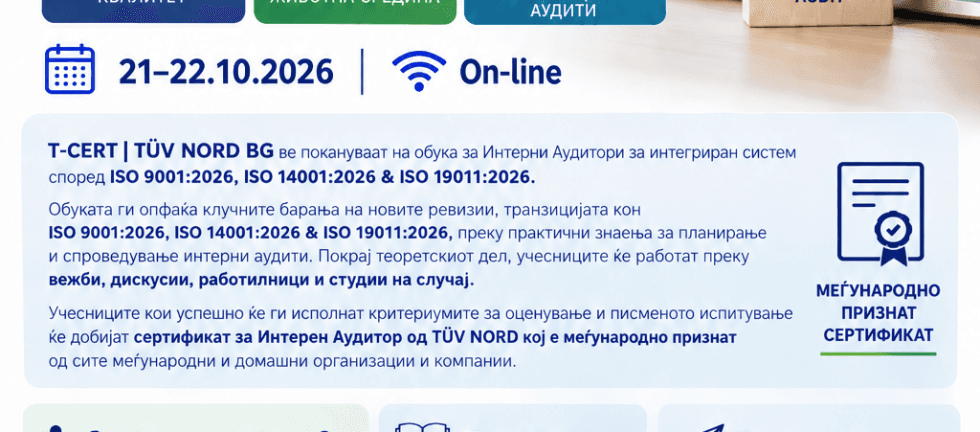 22 Sept 2026New Training for the New Versions of ISO 9001, ISO 14001, and ISO 19011 for Internal Auditors – October 21–22, 2026Read more
 17 Sept 2026The new ISO 9001:2026 has been officially publishedRead more
 4 Sept 2026Training on the NEW VERSIONS of ISO 9001:2026, ISO 14001:2026, ISO 19011:2026 & ISO 45001 for Internal Auditors on 17-18.09.2026Read more