
ISO 9001 – The New Revision Is Ahead of Us
ISO 9001 – The new revision is ahead of us
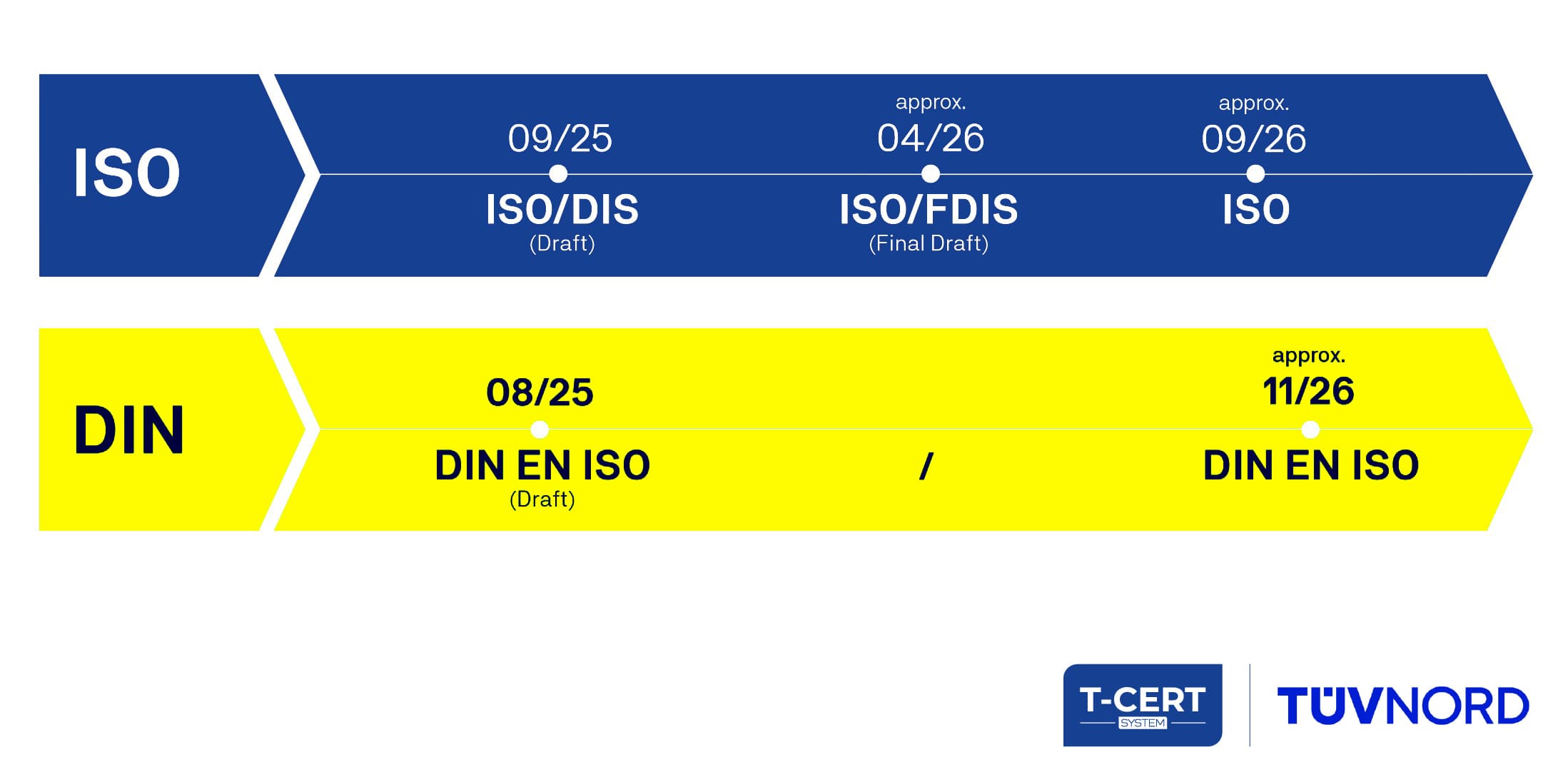
ISO 9001, one of the most universally recognised standards for quality management systems (QMS), is facing a revision. The draft version of the international standard was published towards the end of August 2025 and provides initial insights into the planned changes. However, due to extensive feedback from interested parties, the final publication of ISO 9001:2026 is not expected until the second half of 2026.
Why is the revision necessary?
The current version of ISO 9001 dates from 2015. ISO standards are reviewed every five years in order to ensure that they are up to date and reflect current legal requirements, as well as the evolving needs of organisations and the global economy. Another aim is to improve compatibility with other standards. Among other updates, the forthcoming revision will place greater emphasis on climate protection, which is becoming increasingly important in everyday business practice.
Significant changes in ISO 9001:2026
Integration of the harmonised structure (HS): The standard will be adapted to the new harmonised structure, which replaces the former high level structure and introduces minor changes in content and terminology.
Terms and definitions: Clause 3 is supplemented with relevant terms from the harmonised structure.
Context of the organisation: Clause 4 is extended to include the aspects of climate change, which are now recognised as an important external influencing factor. The content relating to climate change is integrated into the revised version. Although ISO 9001:2026 will not become an ESG standard, the draft emphasises consideration of sustainability aspects. The integration of climate-related content highlights the stronger link between quality and sustainability.
Leadership and commitment: Strategic direction has been added as a new perspective. This relates to clause 5.2.1 e) "Context of the organisation and its strategic direction". The quality policy, objectives and activities should be aligned with the long-term strategy of the organisation. The use of artificial intelligence (AI) may also play a role in this context. This addition emphasises that the context and strategic direction of the organisation should not merely serve as a background, but must be an integral part of the QMS.
Actions to address risks and opportunities: A revision of the risk-based approach (clause 6.1) is being considered. In practice, quality managers are strongly involved in identifying, analysing and managing risks, but tend to neglect opportunities. In today's environment, characterised by uncertainty and unpredictability, it is essential that companies constantly seek opportunities in order to ensure long-term survival on the market. There is also an ongoing discussion as to whether the management of opportunities and risks should be separated, treating them individually.
Awareness: Clause 7.3 is supplemented with requirements relating to the organisation's quality culture and ethical conduct. It is becoming ever clearer that without a supportive corporate culture, management systems remain largely formal. The revised standard aims to connect more closely with real-world practice without becoming too "soft".
Explanation of structure, terminology and concepts: Annex A has been fundamentally revised and now provides detailed explanations of clauses 4 to 10, offering more guidance and clarity in the interpretation and application of the normative requirements.
Removal of Annex B: The informative Annex B will be removed from the standard.
Overall, ISO 9001:2026 represents an important step in the further development of the standard, strengthening the link between quality, strategy and sustainability. Organisations that now begin to familiarise themselves with the forthcoming changes will be better prepared to align their processes, culture and management systems with the revised requirements, ensuring continued compliance and long-term business resilience.
For more information contact us at: office@t-cert.mk, by phone on +389 2 3221 603 or write to us using the contact form.
Keep Reading
Related Articles
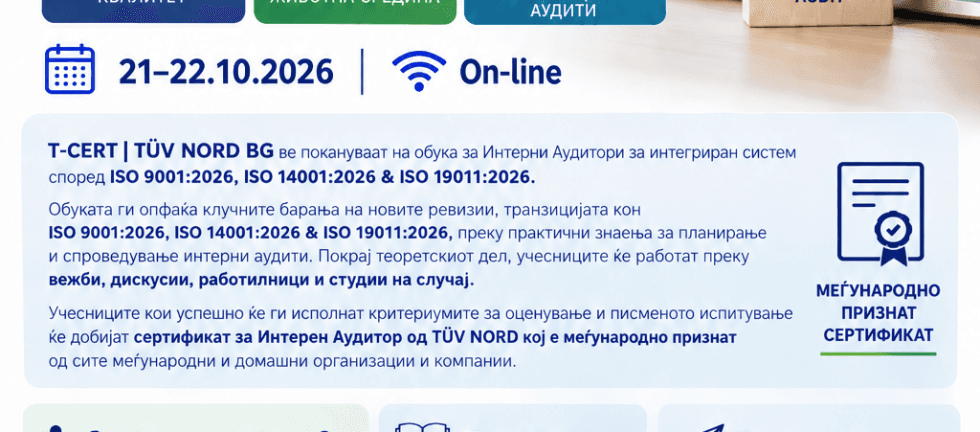 22 Sept 2026New Training for the New Versions of ISO 9001, ISO 14001, and ISO 19011 for Internal Auditors – October 21–22, 2026Read more
 17 Sept 2026The new ISO 9001:2026 has been officially publishedRead more
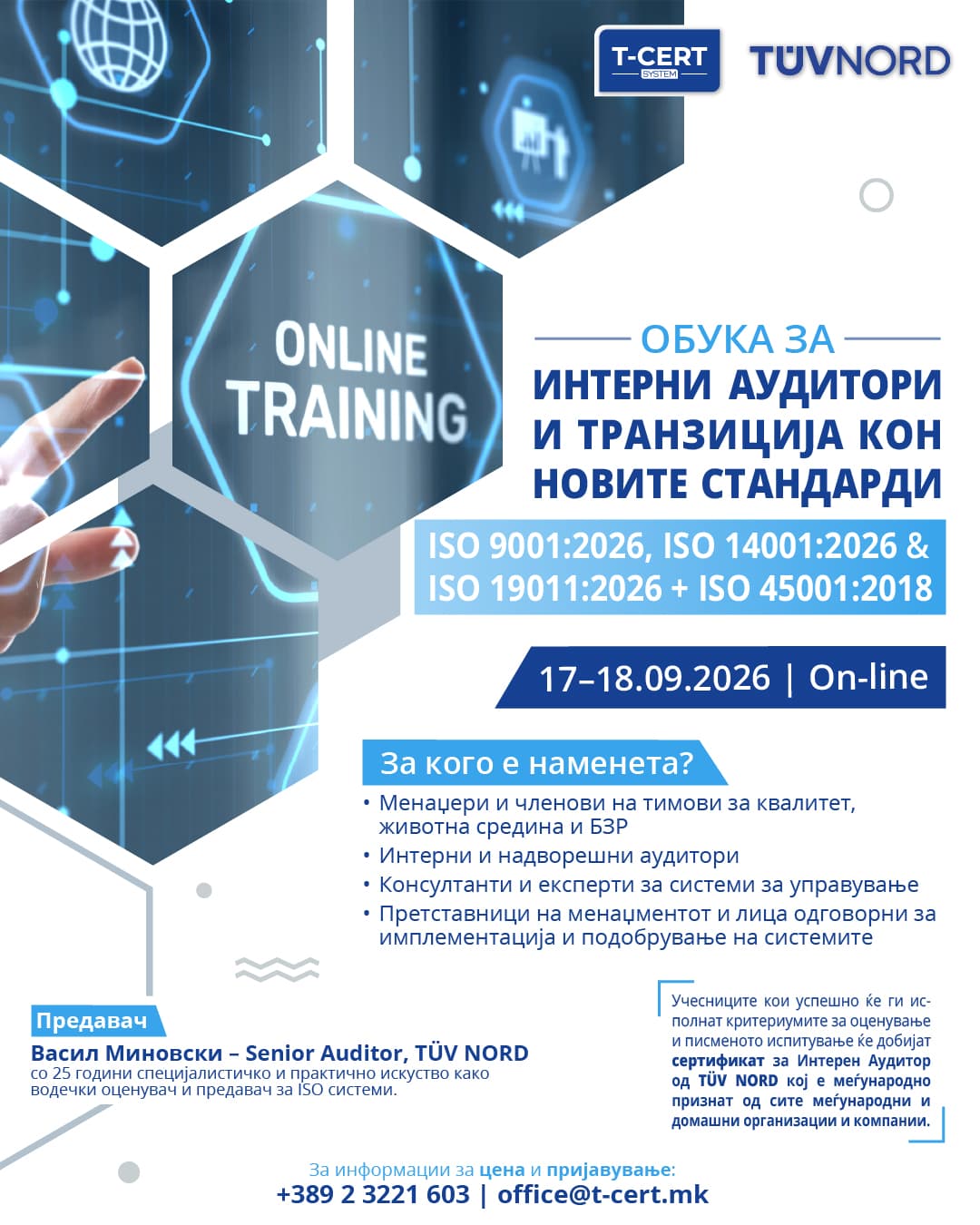 4 Sept 2026Training on the NEW VERSIONS of ISO 9001:2026, ISO 14001:2026, ISO 19011:2026 & ISO 45001 for Internal Auditors on 17-18.09.2026Read more